
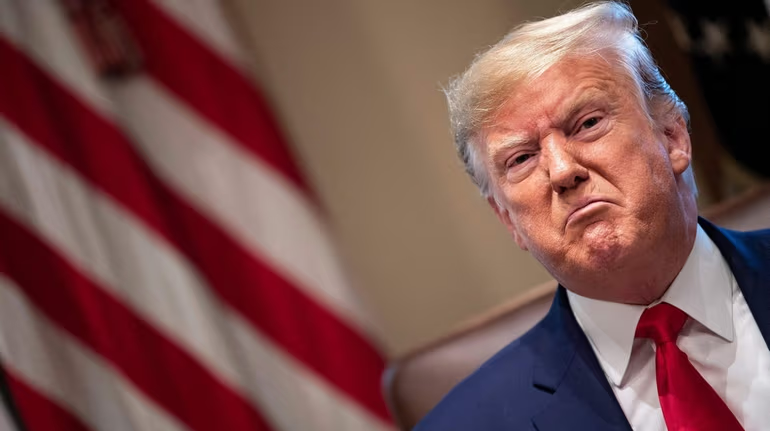
President Donald Trump has reportedly acknowledged the possibility that Republicans could lose control of the House of Representatives in next year’s midterm elections, citing historical trends and some of his own economic policies that have yet to fully bear fruit.
In an interview with the Wall Street Journal from the Oval Office, Trump said he couldn’t predict whether the Republican Party would retain its House majority in November 2026, as the positive effects of his economic agenda might not fully materialize in time.
“I can’t tell you. I don’t know when all this money is going to kick in,” he told the newspaper, referring to the billions of dollars in investments he claims his policies are attracting to the United States.
Trump also acknowledged the political headwinds that the party in power typically faces.
He pointed out that since World War II, only two presidents have seen their party gain seats in the House during midterm elections – Bill Clinton in 1998 and George W. Bush in 2002 – highlighting the considerable historical challenges, even for administrations that claim to be delivering results.
Trump called the upcoming midterm elections “statistically very difficult,” despite his claims that announcements of job creation and investment would eventually translate into better living conditions for voters.
The political risk is compounded by persistent voter frustration over the cost of living.

The Wall Street Journal reported that, despite overall economic growth, many households remain skeptical about the everyday reality of that growth, marked by a slowdown in job creation and rising commodity prices.
Faced with rising food prices, Trump recently reduced tariffs on hundreds of products, a sign that the White House recognizes that inflation concerns continue to weigh on public opinion. Democrats are already seizing on this argument, with their House campaign leaders accusing Trump of failing to deliver on his promises of rapidly lowering costs.
Recent polls suggest that the economy, usually one of Trump’s strongest assets, has become a liability.
A poll conducted by the Associated Press and the NORC Center found that Trump’s approval rating on the economy has fallen to 31%, its lowest level since the poll began. Trump, for his part, told the Wall Street Journal that prices would be “at a good level” by the time the election campaign heats up, blaming Democrats for inflation and advocating tax cuts, deregulation, increased energy production, and a tougher trade policy.
Tariffs are a key component of this strategy. The newspaper noted that the Supreme Court could soon rule on the legality of many of the tariffs imposed by Trump under the International Emergency Economic Powers Act (IEEPA), a decision the president called “catastrophic” for the United States if it goes against him.
Trump is urging Republicans in key states to pursue an unusual mid-decade redistricting effort to increase their number of seats, highlighting that with the Republican Party’s slim majority, even minor changes to electoral maps and variations in voter turnout could determine control of the House of Representatives, according to the New York Post.
The president’s candor reflects a political realism: midterm elections are typically challenging, and voters tend to demand tangible results.
The White House is betting that as new factories, artificial intelligence projects, and manufacturing expansions come online, and as energy and border policies continue to take effect, Republicans will have a stronger case to make.