
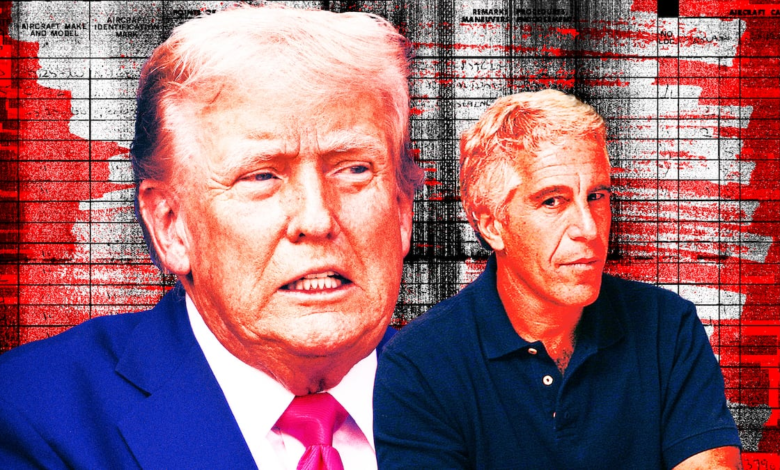
Confidential Justice Department documents reveal that the FBI interviewed a Jeffrey Epstein victim who claimed she was sexually assaulted by President Donald Trump when she was a teenager.
A 21-page presentation summarizing the government’s lengthy investigation into Epstein and his girlfriend Ghislaine Maxwell included two allegations against Trump, whose long-standing relationship with the disgraced New York financier is well-documented. The outcome of the investigation into these allegations remains uncertain.
Under a slide titled “Key Figures,” the presentation stated: “[Name withheld] said Epstein introduced her to Trump, who then forced her to put her head near his exposed penis, which she bit. In response, Trump allegedly punched and kicked her. (Time period: 1983-1985, [Name withheld] was between 13 and 15 years old).”
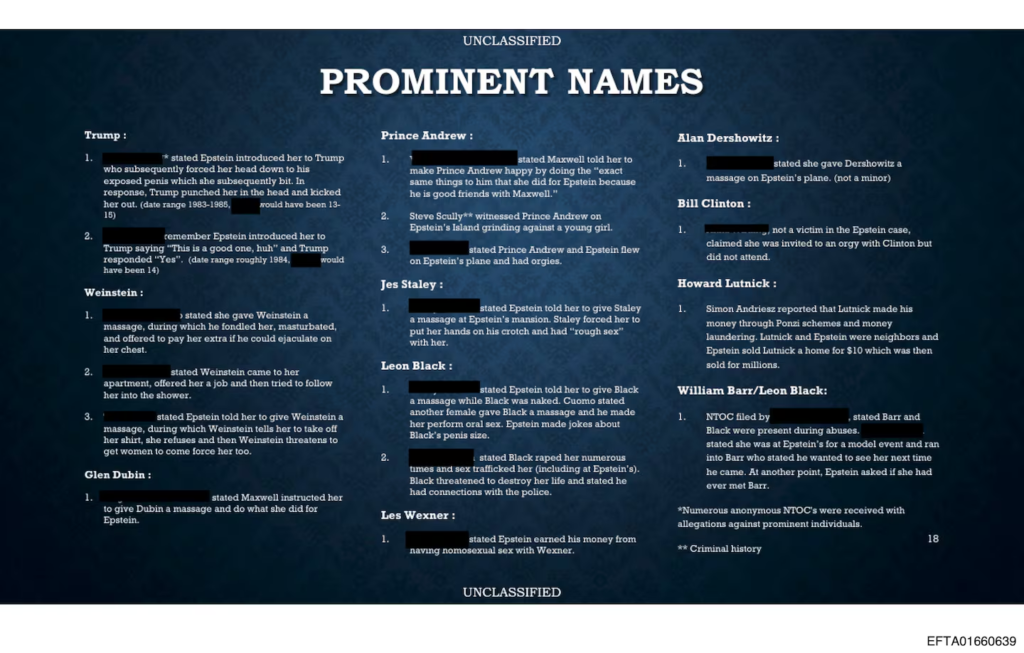
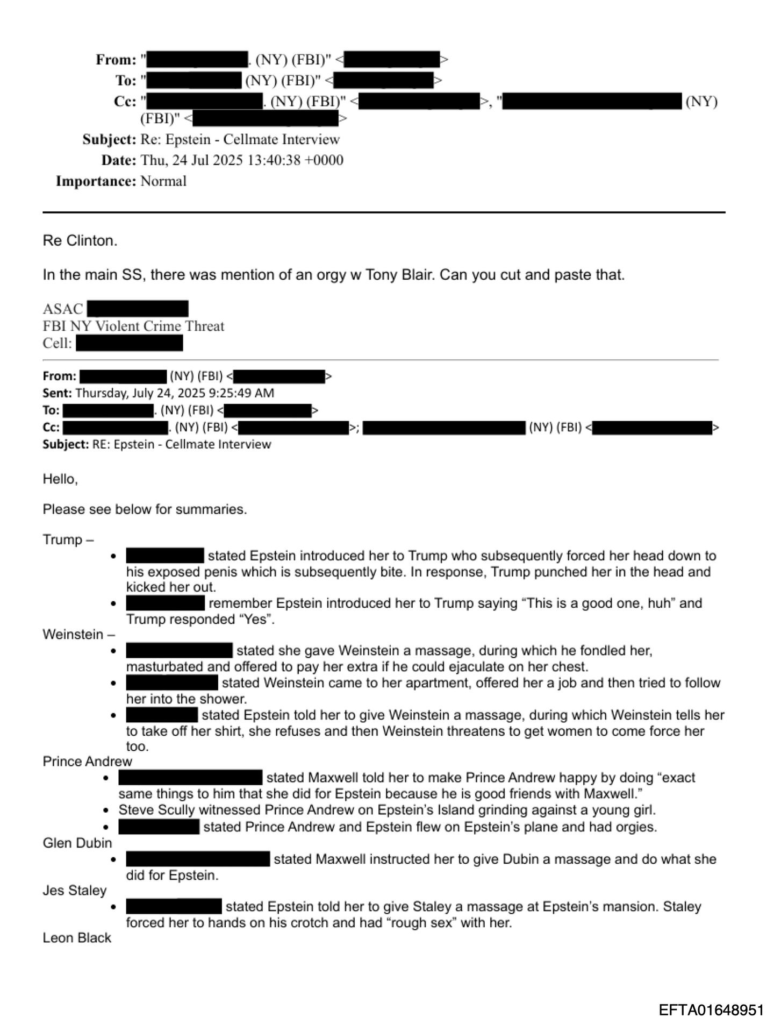
The same allegation appeared in a series of emails exchanged between FBI employees in July 2025.
The assault accusation against Trump appears to have originated from a phone call to the FBI hotline, according to an August 2025 email containing a table of reports.
This table indicated that “[Name withheld] reported that an unidentified friend was forced to perform oral sex on President Trump approximately 35 years ago in New Jersey. This friend told Alexis that she was about 13 or 14 years old at the time and that she allegedly bit President Trump during the act. She also claimed that she was slapped after laughing about the bite. The friend stated that she was also assaulted by Epstein.”
No evidence was presented in the emails or by the FBI to support this allegation.

” Roger Sullenberger was the first to draw attention to the connection between the accusation against Trump and the FBI interview.
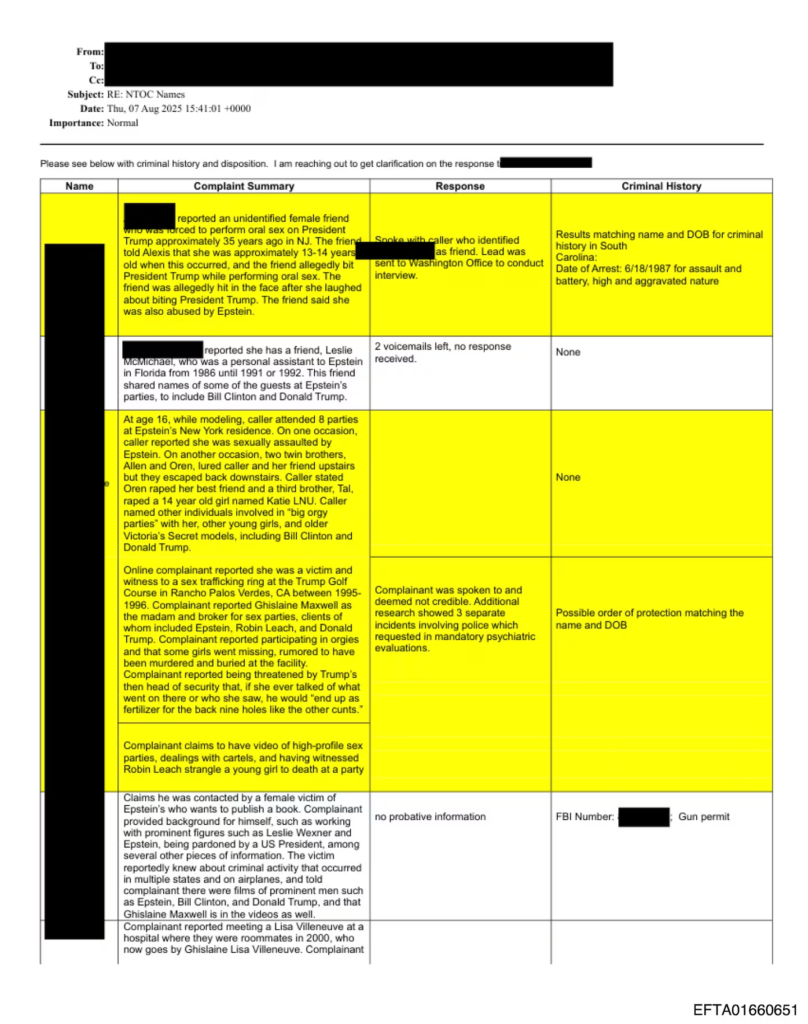
The briefing note indicated that the FBI had acted on the complaint alleging that Trump had assaulted a teenage girl and had dispatched an agent to Washington for an interview. It also stated that “the name and date of birth matched the South Carolina criminal record.”
The personal details contained in the complaint—including the mention of South Carolina and the timeline of events—correspond to those in an FBI report summarizing an interview conducted on July 24, 2019, and logged into the bureau’s system on August 9, 2019, the day before Epstein’s death in a New York City prison.
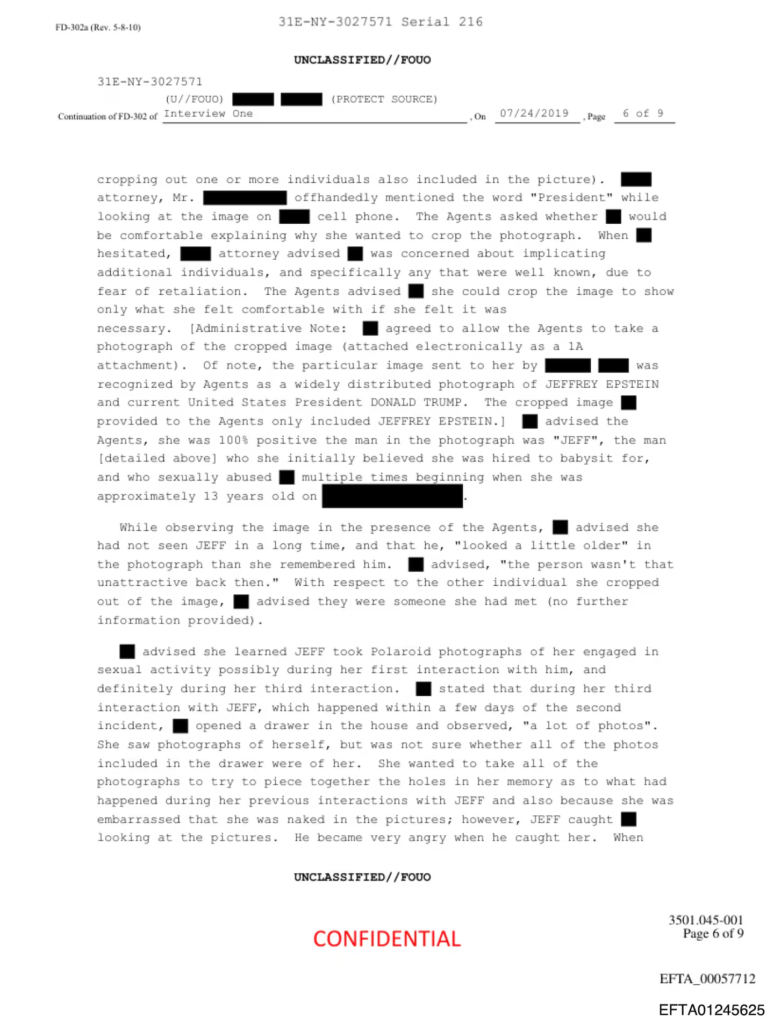
The first two pages of the nine-page document were heavily redacted. The following pages detailed the woman’s account of her encounter with Epstein and the assault she suffered.
According to the document, the woman recalled that her mother had placed an advertisement for her babysitting services in South Carolina in a brochure distributed to renters and homeowners. Her mother received a call from a man who had seen the ad. He told her that he and his wife were looking for a babysitter for the night. She went to meet a man named Jeff at a gated community in Hilton Head, only to later discover that there was no wife or children at the house.
The woman then recounted in detail the sexual assaults she had suffered at the hands of Epstein during several encounters. She explained to investigators that she had been afraid to tell her mother everything because she didn’t want to jeopardize her career and was afraid of getting into trouble.
A few months before her July 2025 interview, the woman said she received a text message from a friend containing the name “Jeffrey Epstein” and a photo.
“Is that him?” her friend asked. The woman replied that the image had “brought back memories,” adding that Epstein’s face was “unforgettable.”
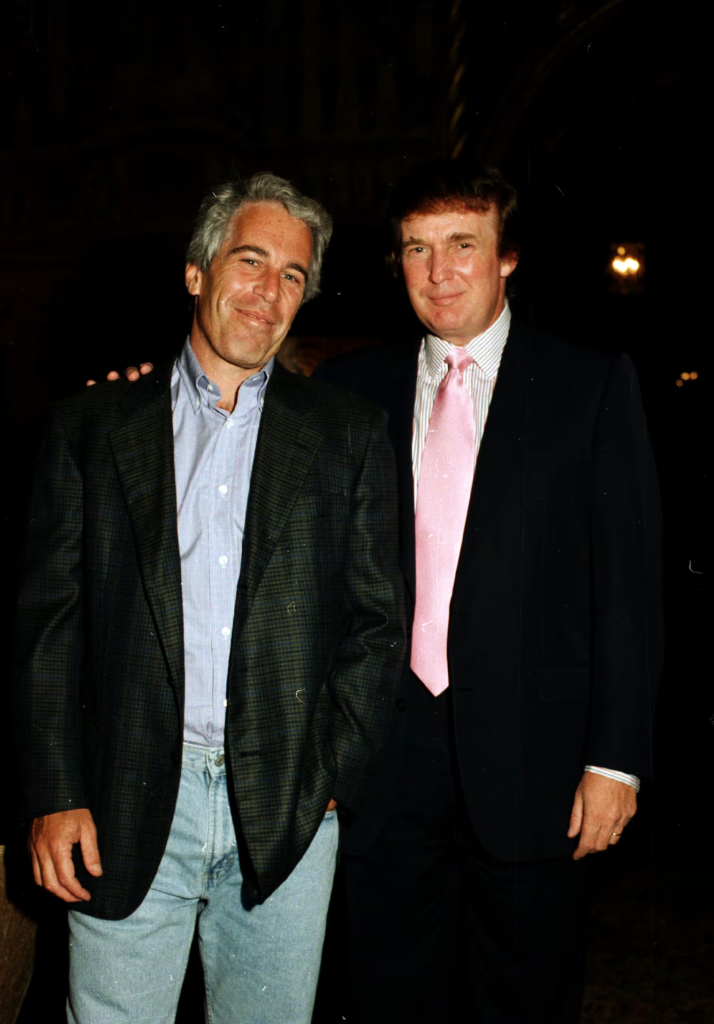
The image was saved in her phone’s messages. Before showing it to the FBI agents interviewing her, she asked if she could crop it to show only Epstein’s face. When asked about the reasons for this request, her lawyer said she “feared implicating other people, including prominent figures, for fear of retaliation,” according to the FBI document.
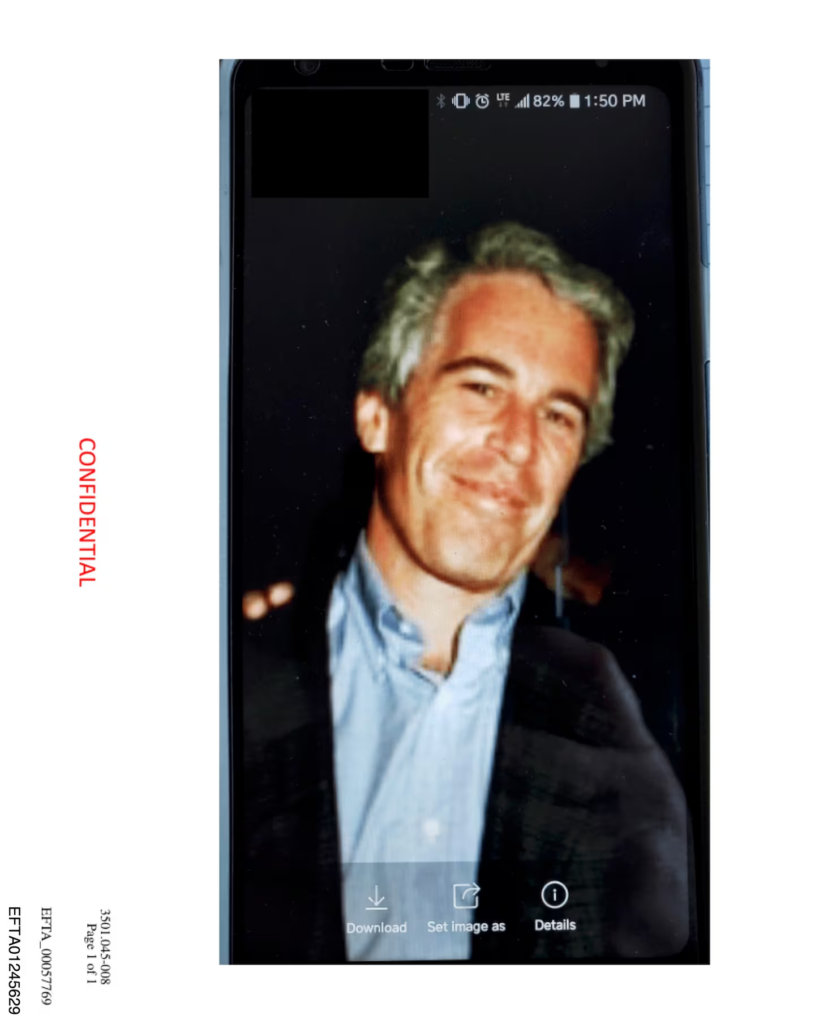
The report continues: “It should be noted that the image she [name withheld] sent to the agents was identified by them as a widely circulated image of JEFFREY EPSTEIN and current U.S. President DONALD TRUMP” The cropped image she [name withheld] provided to agents showed only JEFFREY EPSTEIN.
The woman stated that Epstein “looked older” in the photo than she remembered. As for the other person she cropped—Trump—she [name withheld] indicated that she had met him (without providing further details).
The allegation that Trump sexually assaulted a teenage girl during the interview was not mentioned in the FBI’s written correspondence related to the case.
The information in the files is consistent with public testimony regarding one of Epstein’s victims in South Carolina, who joined a lawsuit against him in 2019 and received compensation from his estate.
The victim, identified as “Jane Doe 4,” alleged in her lawsuit that Epstein hired her as a babysitter around 1984, when she was 13 years old, and sexually assaulted her at his Hilton Head home, according to CNN.
The lawsuit alleges that Epstein took Jane Doe 4 to New York City on “three or four occasions,” where he presented her as “easy prey” at “private gatherings with other influential and wealthy men.”
The lawsuit states: “Jane Doe 4 was violently beaten, assaulted, and raped by these men, whom she met through Epstein. On one occasion, one of these influential men slapped her after forcing her to perform oral sex on him. This same man then raped her vaginally and anally.” “
A separate memo, dated July 2019 and bearing the same case number as the FBI report, indicates that the Seattle FBI conducted the interview and stated that “Epstein’s assault occurred in the 1980s, when the caller was approximately 13 to 15 years old.”
When contacted for comment, the White House referred the caller to a Justice Department statement released last month, coinciding with the release of a large batch of Epstein-related documents.
The statement reads: “This collection may contain falsified or misleadingly presented photos, documents, or videos, as all material submitted to the FBI by the public was included in the collection in accordance with the law.” The Justice Department appeared to be referring to the Epstein Transparency Act, which mandated the release of documents related to the deceased sex offender.
” The Justice Department continued: “Certain documents contain false and controversial allegations against President Trump, which were submitted to the FBI before the 2020 election.” Clearly, these allegations are baseless and false, and if they were credible, they would have already been used against President Trump.
The Justice Department and the FBI did not immediately respond to requests for comment.
On Monday, aboard Air Force One, Trump told reporters that he was exonerated following the release of the Epstein files.
“I have nothing to hide. I’m cleared,” he asserted. “I had nothing to do with Jeffrey Epstein. They were hoping to find something, and they found the exact opposite. I’m totally exonerated.”