
Trump Makes U-Turn One Hour After Trying to Tout Bonkers War Victory
Trump said the U.S. has wiped Iran “off the map”—then threatened new strikes.

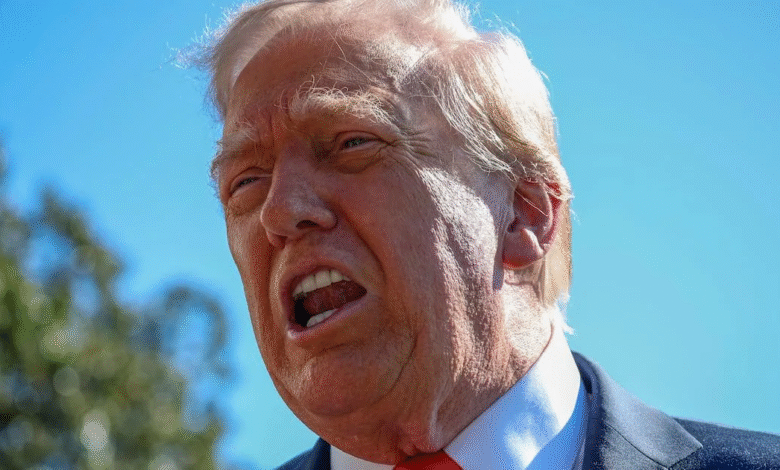
In a social media post, Donald Trump claimed to have “wiped” Iran “off the map,” only to quickly walk back his remarks, threatening to launch new military strikes barely an hour later.
The President first launched a scathing attack via the “Truth Social” platform at 6:37 p.m. (Eastern Time), following the publication of an analysis by The New York Times that questioned how close Trump actually was to achieving his stated objectives regarding military operations against Iran.
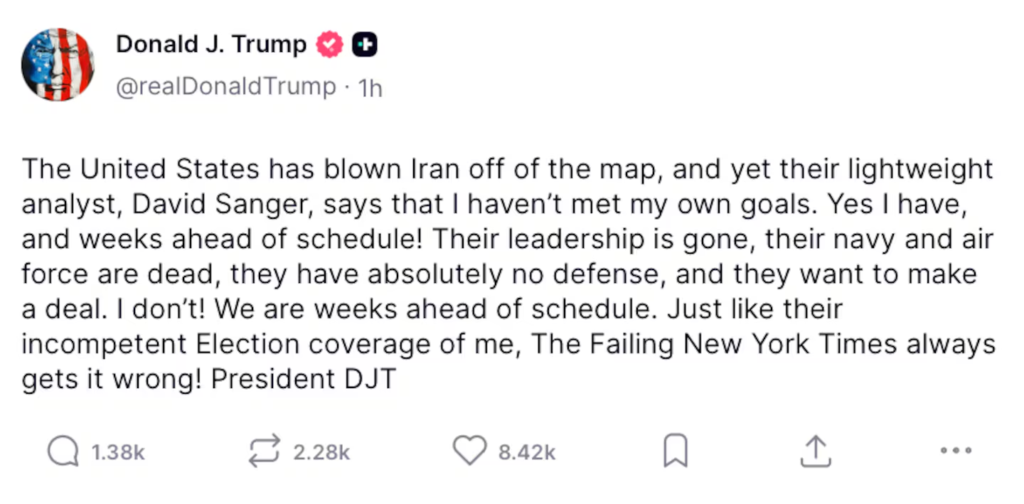
The article noted that “Washington has become entirely preoccupied with the question of when the President will decide to end this campaign—even though many of his war aims remain unfulfilled.”
The article added: “There is growing evidence… suggesting that the repercussions of Mr. Trump’s undertaking could linger far longer than his own interest in it.”
Trump responded with an irate post on Truth Social, insisting that the United States had, in reality, achieved a decisive victory.
“The United States has wiped Iran off the map,” Trump wrote in his post, asserting that the country’s leadership, as well as its naval and air forces, were now “dead,” and that Tehran possessed “absolutely no means of defense.”
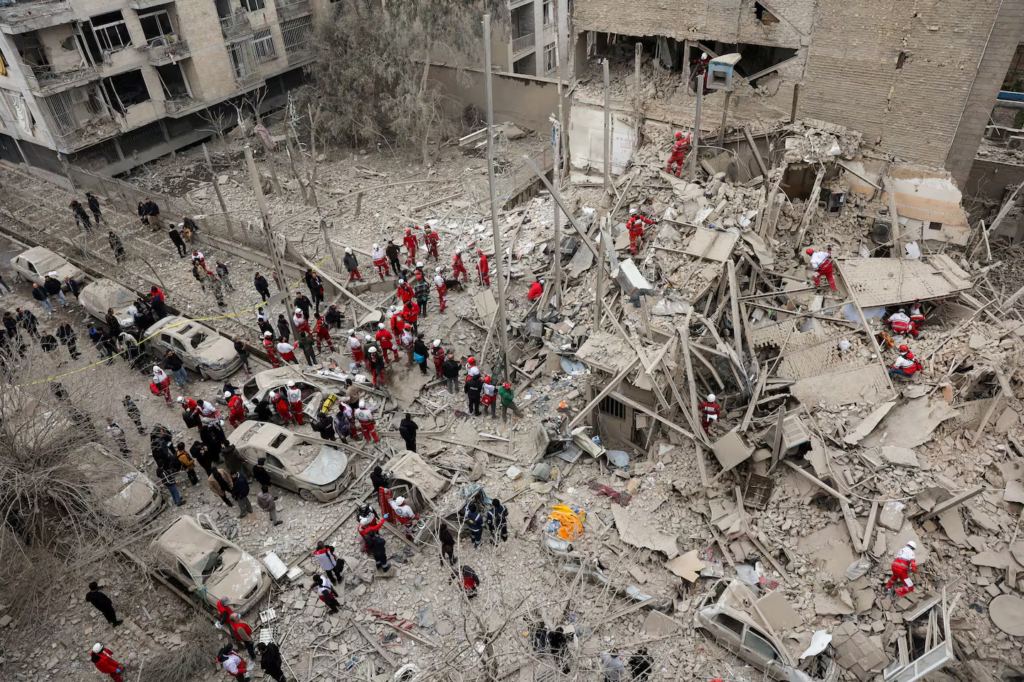
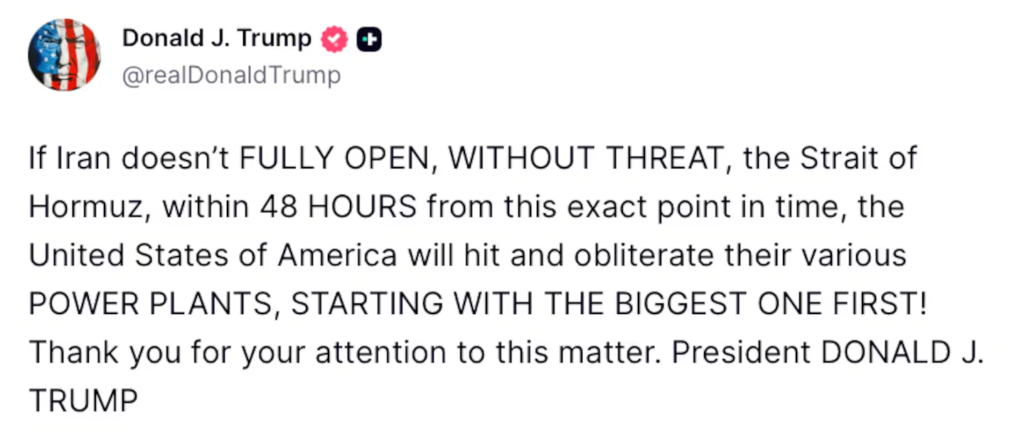
However, just over an hour later—specifically at 7:44 p.m. (Eastern Time)—Trump appeared to undermine his own claims of total victory by issuing a stern ultimatum.
In his second post—written in a distinctly aggressive tone—Trump wrote: “If Iran doesn’t FULLY OPEN, WITHOUT THREAT, the Strait of Hormuz, within 48 HOURS… the United States… will hit and obliterate their various POWER PLANTS,”
This escalation appeared striking and incongruous when juxtaposed with his earlier claims of having achieved total victory. Moreover, this threat has prompted legal warnings, given that the targeting of civilian infrastructure—such as power plants—could be deemed a war crime under international law.
In recent days, Trump has repeatedly hinted that the United States is “very close” to achieving its objectives, while simultaneously ruling out the possibility of reaching a ceasefire—and this comes at a time when preparations are underway to deploy thousands of additional troops to the region, and as the pace of military strikes continues to intensify.
Furthermore, his definition of “victory” remains in a state of perpetual flux and constant evolution.
The initial demands articulated by Trump—calling for Iran’s “unconditional surrender”—have faded, replaced by a more flexible and broader objective: preventing Tehran from developing a nuclear weapon. This is an objective that Trump had, in fact, already claimed to have achieved last year, following strikes launched by the United States and Israel against key Iranian nuclear sites.
At the time, he declared: “We have completed our very successful attack on the three Nuclear sites in Iran…NOW IS THE TIME FOR PEACE!”—remarks he posted on the “Truth Social” platform last June.
Nevertheless, nearly a year later, Trump continues to threaten to launch fresh strikes and is redefining the very notion of “victory,” in a frantic and desperate attempt to find a way out of this ever-escalating conflict.

According to The New York Times, Trump has begun publicly hinting that he might “scale back” operations; yet, military movements show few signs of slowing down.
Earlier this week, military forces were deployed to the Middle East amidst preparations for a potential ground operation inside Iran.
The mixed signals point to competing pressures pulling Trump in opposite directions: on the one hand, Trump has sought to portray the situation as a resounding victory; on the other, the lingering economic and political repercussions have become too difficult for the administration to ignore.
Instability in the Strait of Hormuz—a vital shipping lane for global energy supplies—has unsettled oil markets and driven up prices, while U.S. allies—largely kept on the sidelines of the conflict—have shown very little appetite for intervention.
The White House did not immediately respond to a request for comment.
In response to an inquiry, Charlie Stadtlander, a spokesperson for The New York Times, stated: “In his work, David Sanger draws upon more than 40 years of experience as a foreign affairs and Washington correspondent for The Times, as well as his established reputation for neutrality and non-partisanship. His article offers a fair and comprehensive analysis of what U.S. military and diplomatic officials have accomplished thus far—and the areas where they have fallen short—while helping the country understand the current state of the conflict and the options available to the President moving forward. This is precisely the kind of analysis one expects from an independent journalist.”