
Massie Threatens to Go ‘Nuclear’ and Reveal Epstein Client Names If Bondi Won’t Unredact Them
After getting the opportunity to view the unredacted files, Rep. Thomas Massie threatened to read the names on the House floor to secure justice for survivors.

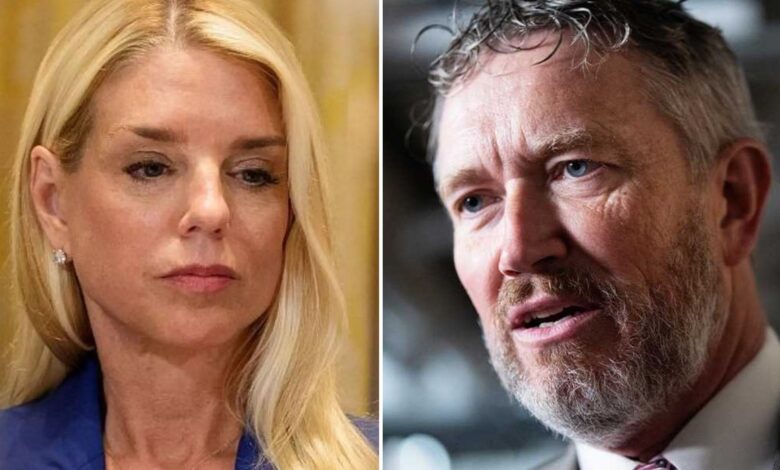
While three million files related to Jeffrey Epstein remain inaccessible to the public, and the names of many potential clients and associates remain secret, Representative Thomas Massie is threatening to use what he calls the “nuclear option” to force the Trump administration’s Justice Department to be transparent.
Macey (R-Ky.), who has been more vehement than any other Republican in his efforts to secure the release of files concerning the deceased sex offender and his influential circle, will join Representative Ro Khanna (D-Calif.) on Monday to review the Justice Department’s entire file, uncensored.
Under legislation introduced by Massie and Khanna last year, and passed by Congress almost unanimously, the Justice Department was required to release all files by December, uncensored, to protect public figures from embarrassment, reputational damage, or political risk.
However, millions of files remain inaccessible, while those that have been released—including a batch of more than three million files published in late July—have been heavily redacted.
These files contained numerous references to Trump, as well as to other influential figures, including former President Bill Clinton, tech billionaires Elon Musk and Bill Gates, and former British Ambassador to the United States, Peter Mandelson.
At the same time, files containing compromising references to Trump were posted online before being quickly removed. Among these files was a list of unverified FBI reports describing the president’s involvement in horrific cases of child sexual abuse.


During his appearance on CNN’s “Inside Politics” on Sunday, Massie accused the Trump administration of breaking the law by failing to respect the release deadline and by disclosing the names of victims while concealing those of alleged perpetrators.
He stated that FBI File 302 was particularly interesting because it contained information from official interviews with witnesses and victims of Epstein, information that the Justice Department, he said, continues to refuse to release.
He added that the Justice Department is “over-censoring” documents relating to “certain highly suspicious emails” exchanged between Epstein and his associates, the sender of which “we cannot identify.”
Massey said that Attorney General Pam Bondi “will appear before my committee,” referring to the House Judiciary Committee, on Wednesday to answer questions regarding the release of the files.
He explained that he intends to ask her why the remaining documents have not been released, why—despite delays that would have allowed authorities to redact information that could identify victims—the names of some of them have been released, and what information has been redacted from the files.
In response to a question from host Manu Raju about how he would react to the Justice Department’s continued violation of the law, Massey said he was prepared to read the names of Epstein’s clients to the House, provided the victims felt that “the best way to get justice is to force the Justice Department to release those names.”
Massey also pointed out that the latest filings revealed that Howard Lutnick, the Trump administration’s Commerce Secretary, who claimed to have severed all ties with Epstein in 2005, had in fact maintained business and personal relationships with him for years after his 2008 sex trafficking conviction. These relationships included joint business ventures, dinners, and a planned trip to Epstein’s infamous private island in 2012.
When asked whether Lutnick should testify before the Judiciary Committee, Massey replied, “No, he should resign.”
He added that Mandelson and former Prince Andrew, another close associate of Epstein who was stripped of his royal title, had resigned from their positions following a scandal, “for reasons far less serious than those mentioned by Lutnick.”
On Friday, under mounting pressure from lawmakers and the public, the U.S. Department of Justice sent a letter to members of Congress—obtained by The Associated Press—informing them that they could review the documents.
Lawmakers were required to notify the Justice Department 24 hours in advance and review the documents in a secure reading room. They were prohibited from creating electronic copies for distribution, but were allowed to take notes.
On Sunday, in a social media post, Massie invited interested followers to suggest troubling documents they wanted him to review, specifying that those receiving the most “likes” would be given priority.
Among the documents that have generated the most outrage and calls for transparency are:
- A 2014 email in which an unidentified person thanked Epstein for “a pleasant evening” and told him that “his little girl had been a bit naughty”;
- Another email from 2014, in which an anonymous source stated they were giving Epstein “permission to kill” an unidentified person;
- An email from 2009, in which an anonymous source told Epstein he “liked the torture video”;
- And a heavily redacted memo from the U.S. Attorney’s Office, sent after Epstein’s death in 2019 to then-U.S. Attorney General Geoffrey Berman, outlining the steps of the investigation and the potential liability of Epstein’s associates, as well as several unverified allegations of collusion and participation in his crimes. This document was removed shortly after being posted on the Justice Department’s website.
On the very day lawmakers were scheduled to review Justice Department documents, Ghislaine Maxwell, Epstein’s associate sentenced to 20 years in prison for sex trafficking of minors, refused to answer questions from the House Oversight Committee regarding the identities of others involved in Epstein’s abuse, citing her constitutional right against self-incrimination.
As Khanna pointed out, she also failed to invoke this right in July when she privately answered questions from Assistant Attorney General Todd Blanch.
Khanna sent a letter to House Oversight Committee Chairman James Comer (R-Kentucky), outlining her questions for Maxwell concerning the information she possessed about other associates, the extent of Epstein’s and Trump’s involvement, and whether Trump had offered her a pardon in exchange for her silence.
“Americans will see this inconsistency,” Khanna told reporters on Monday. “Why didn’t she exercise her right to remain silent when Blanch asked her questions, whereas now she’s using it to remain silent about facts that don’t directly concern her, but which could implicate many other influential people from the same circle as Epstein, who committed these crimes?”