
MAGA Dolt Hegseth Accidentally Reveals Big Hole in Trump Victory Claim
So Iran came to the table because Trump threatened to blow up their civilization, eh? Sorry, that spin is in tatters.

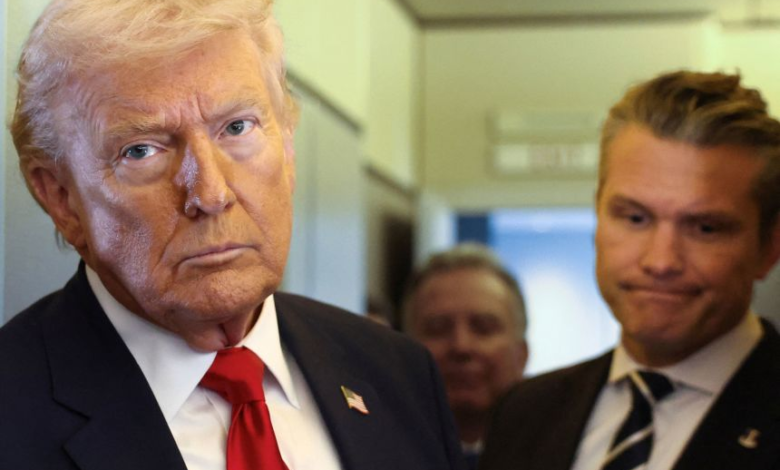
Now that Donald Trump has walked back his threat to annihilate a nation of 93 million people, his propagandists have scrambled to reframe the narrative, transforming that very threat into proof of what they portray as Trump’s foresight and “Solomonic” wisdom. This new narrative posits that war with Iran has been temporarily suspended by a ceasefire—precisely because Trump issued that threat—thereby compelling Iran to return to the negotiating table on more favorable terms.
Responding to questions from reporters on Wednesday regarding Trump’s threat, Pete Hegseth, a Pentagon official, stated: “Iran eventually realized that its ability to produce, to generate power, and to fuel its terrorist regime lay in our hands.” Hegseth insisted that Trump’s pledge to annihilate an “entire civilization” had convinced Iran that he possessed the capability to crush its capacity to “export energy”—thereby eliminating the fundamental pillar upon which the Iranian regime’s very existence rests.
Hegseth continued: “It is precisely this type of threat that cornered them into a position where they, in essence, declared: ‘We want to make this deal.’” This talking point has circulated widely; Representative Mike Lawler (R-NY)—one of the Democrats’ top political targets—remarked that, thanks to Trump’s “extreme rhetoric,” the Iranians had “realized, for the first time, that they actually had to engage in real negotiations.”
However, there is a small problem with this narrative. That problem is simply this: the Iranians were already engaged in negotiations with Trump even before hostilities broke out. However, Trump deliberately and significantly sabotaged these negotiations, having yielded to those who had convinced him that a war would be an easy undertaking that would bring him swift, fleeting glory. The approach Trump adopted during these talks rendered any success impossible—a result he pursued with deliberate intent and design.
As revealed by an extensive investigation published by The New York Times on the subject, Trump had already made the decision to go to war—with only the timing left to be determined—weeks before negotiations with Iran reached their critical phase. This was due, in part, to Israeli Prime Minister Benjamin Netanyahu’s success in convincing Trump that the risks of war could be contained and controlled, and that military strikes would sufficiently weaken the Iranian regime to prevent it from closing the Strait of Hormuz (a belief that subsequently proved catastrophically wrong). The New York Times reports that U.S. intelligence officials expressed reservations regarding the excessive confidence displayed by the Israeli side concerning these assessments; yet, Trump brushed these warnings aside, as he “seemed to believe that the war would be extremely quick and brief.”
The pre-war negotiations with Iran were doomed to fail from the outset, given that Trump constantly shifted his objectives and demands in a manner that guaranteed precisely that outcome. The central issue of the negotiations appeared, on the surface, to focus on eliminating Iran’s capacity to develop nuclear weapons. However, The Times also reveals that Iran was, in reality, prepared to make substantial concessions on this specific front. Nevertheless, Trump administration officials effectively decided that nothing short of regime change would be acceptable—a stance that rendered war inevitable.
For Hegseth’s narrative to hold true, Iran would have had to demonstrate a greater willingness to make the concessions sought by Trump—under the weight of his severe threats—than it had previously shown. Yet, although the war inflicted grave damage on Iran’s military capabilities and claimed the lives of numerous high-ranking commanders, we are also confronted with other realities: the regime still stands and has, in fact, adopted an even more radical and brutal character. Moreover, the strait is now in the process of reopening; however—as Ben Rhodes points out—the regime’s grip on it appears to have tightened even further than before. The fate of Iran’s nuclear materials, meanwhile, remains unknown and unresolved—exactly as was the case in the past.
Will the talks currently underway with Trump result in a better deal than the one he would have secured the first time around? Perhaps; yet, thanks to its resilience, Iran appears bolder in its demands this time. Indeed, the points Trump has accepted as a basis for negotiation seem more favorable to Iran than they were previously.
In this context, Sina Toossi, a senior research analyst at the Center for International Policy, told me: “Iran is sitting at the negotiating table because Trump now appears willing to base the talks on a broader range of Iranian demands.” Toossi cites as evidence Trump’s apparent willingness to consider a complete lifting of U.S. sanctions, the preservation of Iranian control over the Strait, and the authorization of some form of uranium enrichment; adding: “The threat of ‘civilizational eradication’ played no role whatsoever in securing a ceasefire.”
So, what did this threat—issued by Trump and which would have constituted a massive war crime—actually achieve? Its results have been purely negative. As Bill Kristol writes:
Trump’s war has further shaken any confidence our allies might still have in us. It will be seen as confirmation that Trump’s United States of America has become just another rogue nation in the international arena, if a less disciplined and cunning one than Putin’s Russia or Xi’s China.
Kristol is referring here to the overall impact of the conflict; however, the threat of “civilizational eradication” brandished by Trump also contributed to bringing these consequences to fruition. The mere fact that an American president could enthusiastically vow to annihilate a nation of 93 million people is grave enough in itself. Worse still: the American political system appeared utterly powerless to stem this threat—largely because one of our major parties revealed that it would not lift a finger to fulfill its duty, even when its leader threatened to commit massive, nearly unimaginable war crimes—or even genocide.
As Brian Beutler points out, Republicans—who recoiled at the idea of opposing Trump’s insane schemes—were lucky that he backed down at the decisive moment. But next time, they may not be so lucky; and neither, in all likelihood, will we. Indeed, we must also ask ourselves what demoralizing psychological toll this spectacle—which exposed our profound powerlessness in the face of Trump’s madness—will ultimately exact from the millions of Americans for whom the very idea that their country could threaten such indiscriminate and barbaric destruction is deeply unsettling; a group that surely includes many ordinary Republicans.
One might hope that this galvanizes millions of voters to cast their ballots against the Republican Party in the midterm elections—and it will likely contribute to that end—but transforming this momentum into genuine checks and balances capable of preventing the return of such madness remains an extremely arduous task; and that, in itself, is a painful realization to bear.
In a sense, Hegseth’s attempt to steer the narrative actually does us a public service. By insisting that it was Trump’s threats that compelled Iran to come to the negotiating table, he forces us to re-evaluate the reasons that led to the failure of the initial talks, the motives that drove us to go to war in the first place, and what those hollow, brutal, and counterproductive threats—issued by Trump—have truly accomplished. It is a story of total and abject failure in every respect; these threats have yielded nothing but disastrous consequences—a reality that exposes a new facet of this catastrophe and deals yet another blow to Trump’s claim of victory.
This stems from the fact that the central narrative woven by Trump and Hegseth regarding this war rests on the premise that it serves as a demonstration—a proof—that American power and hegemony are absolute, indisputable, and capable of accomplishing literally anything. This includes the mere threat of unleashing that power; for if the specter of American military violence—and the intimidation it imposes—is capable of bending literally any adversary to Trump’s will, then extreme threats of annihilation are, in their view, inherently virtuous. Consequently, Hegseth relentlessly boasts of America’s superior capacity to kill, displaying it with unsettling zeal and a palpable bloodlust—all for the purpose of entrenching this specific narrative.
However, that narrative has suffered a devastating blow. While it is true that the war showcased astonishing technological prowess, that prowess is utterly devoid of the capacity to accomplish—literally—the slightest thing that Trump desires. Nor does the mere threat of unleashing a deluge of force of such intensity upon millions of innocent people—amidst a brutality and savagery that know neither bounds nor limits—possess this capacity. Trump and Hegseth set out to prove otherwise; yet, they failed miserably in this endeavor as well.