
Democrats Plan to Target Supreme Court Citizens United Ruling
Democrats are taking aim at a Supreme Court ruling that unleashed big money in politics.

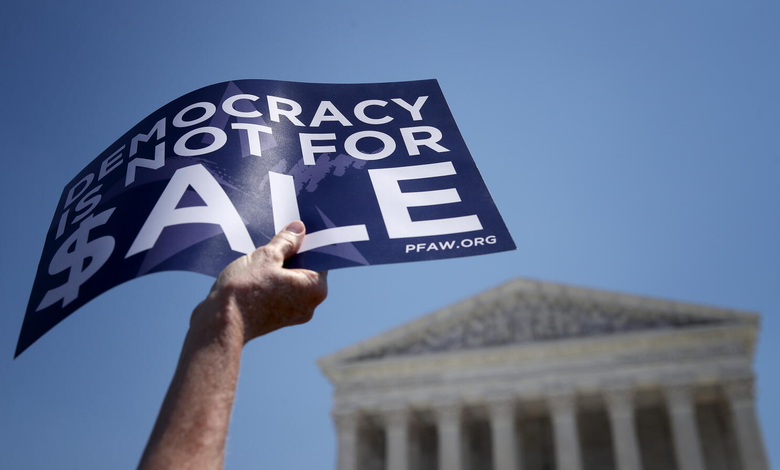
Democrats are preparing to take back control of Congress, having pledged to combat corruption in Washington. This commitment includes a call to overturn a landmark Supreme Court ruling that threw the door wide open to a massive influx of money into election campaigns.
The 2010 ruling in the case of Citizens United v. Federal Election Commission (FEC) removed restrictions on election spending by corporations. This decision facilitated the injection of billions of dollars into political causes in the United States and led to a sharp rise in so-called “dark money” (undisclosed donations).
Nearly all of the 13 newly elected Democratic senators have pledged to work toward overturning this ruling—a position also held by Hakeem Jeffries, the Democratic candidate for Speaker of the House. However, passing a simple law may prove insufficient, as the Citizens United decision is fundamentally rooted in the right of corporations to freedom of speech, as guaranteed by the Constitution.
Richard Pildes, a law professor at New York University, points out that “unless the Supreme Court itself reverses its decision, overturning it would require a constitutional amendment.”
Adopting a constitutional amendment involves overcoming several hurdles: it requires approval from two-thirds of the members of both chambers of Congress, followed by ratification by three-quarters of the states in order for it to be incorporated into the Constitution. It is worth noting that the most recent amendment to the Constitution—which addressed an anti-corruption measure concerning salary increases for members of Congress—was ratified in 1992.
However, the Citizens United case can be seen as a symbol of a broader, more widespread discontent that extends well beyond the scope of that 5-to-4 ruling. Other proposals put forward during election campaigns—such as requiring all political donors to disclose their identities—do not necessarily require a constitutional amendment.
This is because one of the fundamental principles established by the Citizens United decision is that, while governments cannot prohibit political expression by corporations, they are entitled to regulate it by imposing disclosure and transparency requirements.
Ciara Torres-Spelliscy, a law professor at Stetson University, explains: “If the reform involves improving disclosure mechanisms to eliminate ‘dark money,’ then the Citizens United ruling permits and supports such an approach.”
$12 billion
The 2026 midterm elections were marked by a campaign that shattered all records for political spending; according to estimates by the organization OpenSecrets, total expenditures surpassed the $12 billion mark. “Super PACs”—funded largely by billionaires and corporations and operating independently of the candidates—continue to drive this surge. A striking example is Elon Musk, who donated more than $445 million to Republican-affiliated committees. Michael R. Bloomberg was also among the top donors, contributing $116 million in support of the Democrats. (It should be noted that Michael Bloomberg’s companies are managed by entities he controls.)
Furthermore, the organization “OpenSecrets” has indicated that donations from “anonymous sources”—made to “super political action committees” (super PACs) by organizations that do not disclose the identities of their backers—will exceed $1.5 billion during this election cycle.
According to Dan Weiner, senior director of the Elections and Government Program at the Brennan Center, a decisive victory for the Democrats—who have sought to distance money from politics—would mark a “turning point.” “Public anger transcends partisan divides,” he notes.
Democrats in both the House of Representatives and the Senate have already proposed an amendment titled “Citizens Over Corporations,” which they argue would help limit spending by candidates and other actors intended to influence elections.
Legal experts note that such language goes beyond Citizens United and also targets Buckley v. Valeo, a separate Supreme Court decision from 1976 that said Congress couldn’t limit independent spending in elections under the First Amendment.
That would be key to any effort to limit the influence of individual billionaires and not just corporations.
New Congress
Among the legislative measures debated by Congress over the years is the “DISCLOSE Act.” This bill aims to require outside groups to reveal the identities of their donors and to enhance transparency regarding political advertising.
In October, Senator Chris Van Hollen (Democrat from Maryland) and Representative Robert Garcia (Democrat from California) introduced a bill targeting what they call the “Musk loophole.” This legislation seeks to prohibit individuals or entities with federal contracts from making donations to political parties or federal election campaigns.
Any proposal originating in Congress would require, at the very least, some support from the Republican Party in the Senate, making its passage uncertain. It should be noted that Democrats hold a 56-to-44 seat majority in the Senate, while in the House of Representatives, they currently hold 259 seats compared to 173 for the Republicans.
Furthermore, some lawmakers, such as Senator Josh Hawley (Republican from Missouri), have advocated for legislative measures aimed at challenging the Supreme Court’s decision in the Citizens United case. Weiner—whose group advocates for the establishment of new rules regarding campaign finance—pointed out that the “Disclosure Act” fell just one vote short of the majority needed to overcome a filibuster when it was first introduced in 2010.
“Today, we are dealing with a Democratic Party and a Republican Party that are very different from what they once were,” Weiner stated. “I am convinced that we will see an evolution in the next Congress and beyond; even Donald Trump might take unpredictable positions on such issues.”
Although Trump—who will hold veto power—occasionally criticized the influence of money in politics during his 2016 presidential campaign, his primary Super PAC raised more than $400 million that year, with a large portion of those funds coming from donations made by billionaires.
‘More Momentum’
In the majority opinion for the Citizens United case, former Justice Anthony Kennedy explained that the ruling was part of a series of decisions recognizing that the protection of freedom of speech also applies to corporations.
However, the decision sparked widespread public opposition, which has only intensified over time; a 2015 poll conducted by Bloomberg found that 78% of respondents favored overturning the ruling. A decade later, newly elected lawmakers Abdul El-Sayed (Democrat from Michigan) and James Talarico (Democrat from Texas) have pledged to make this issue a top priority upon entering Congress. During a campaign stop, Representative-elect Mary Peltola (Democrat from Alaska) stated: “After a season marked by a barrage of aggressive advertising, I think we are ready to take up the fight against the ‘Citizens United’ decision.”
For his part, Beldis asserted: “The current momentum is stronger than it has been at any point since the ‘Citizens United’ ruling. The colossal sums spent by Elon Musk have served as a key catalyst, deepening the commitment of many Democrats to this cause.”